
Introduction
When Theresa Marks joined the Center for Planetary Management for a recent conversation, she brought with her a simple but profound question:
What spiritual freedoms belong to every human being?
Drawing from her own journey through and beyond authoritarian religion, Theresa shared the inspiration behind the Spiritual Bill of Rights for Humanity—a framework designed to affirm spiritual freedom, personal sovereignty, and each individual’s direct relationship with the Creator.
In the conversation that follows, Theresa explores the origins of the Spiritual Bill of Rights, the seven spiritual freedoms it affirms, and her vision for a future grounded in freedom of conscience, personal spiritual experience, and what she calls “oppression-free religion.”
The Origins of the Spiritual Bill of Rights
Kona: Theresa, thank you for being here. You’re here to share the Spiritual Bill of Rights for Humanity. Before we look at the presentation itself, please tell us how this came to be.
Theresa: Well, it was two years ago. I was undertaking a program to become a spiritual director, and I knew from my own personal experience, having come out of an authoritarian religion myself, that I wanted to focus on working with people who had been hurt by religion.
As I was doing my final project, I kept asking myself, “How can I really help these people? And how can I perhaps come up with a way to prevent this kind of hurt from happening?”
At that very moment, I got this flash in my mind. I think it was from Christ Michael—Jesus has been my guide in this the whole time—and the message was: “You will write a Spiritual Bill of Rights for Humanity.”
I just thought, wow. A Spiritual Bill of Rights. This is a way that we can formally declare that people have spiritual rights—that they don’t have to be forced by religions to believe certain things or practice certain ways, and that everyone has the right to their own discovery of truth.
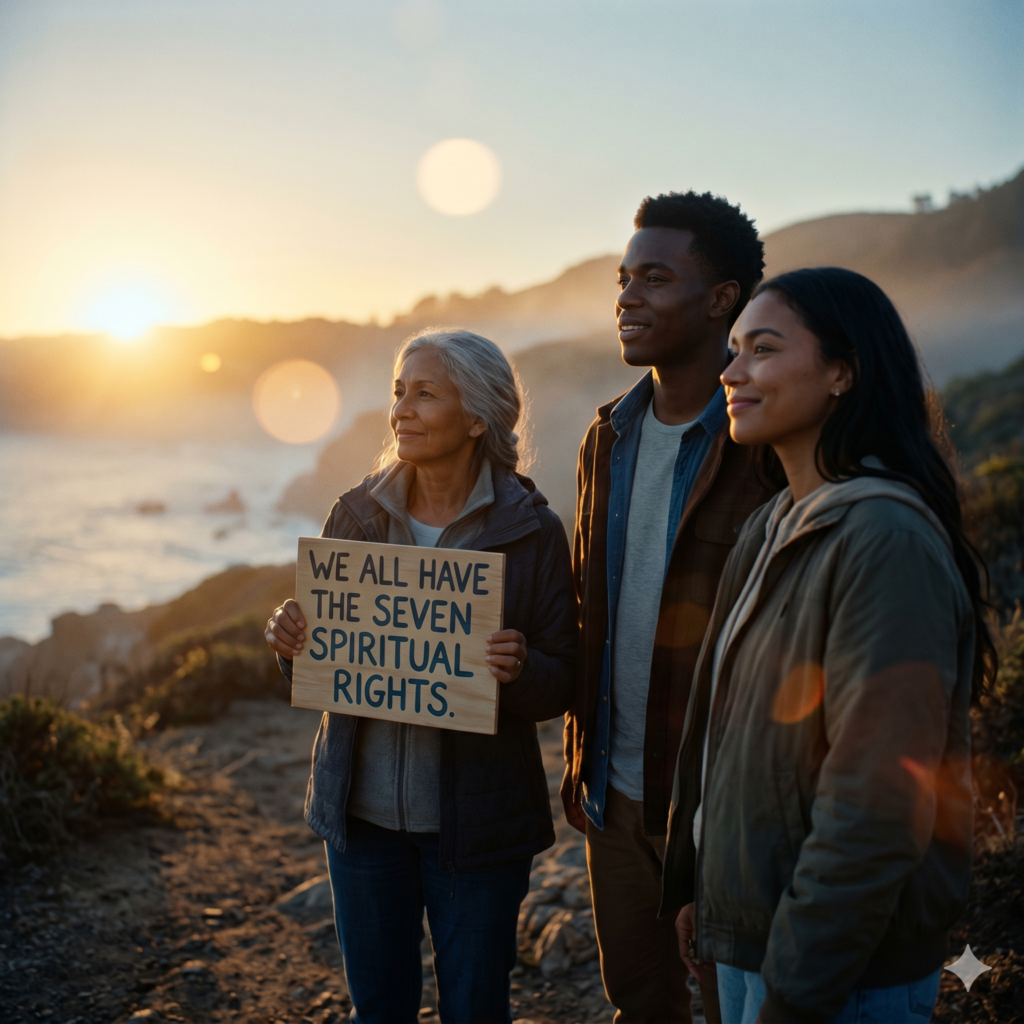
It took me a few months, but I wrote the original version in 2023. In my upcoming book there will be a slightly updated version, but basically there are seven rights in the Spiritual Bill of Rights.
The Seven Spiritual Rights
I’d like to introduce you to those seven spiritual rights and why they’re important.
These rights are bestowed by the Creator on all people. They flow directly from the gift of free will, and they should never be violated by people or institutions.
The first right is the right to connect with the Creator in our own unique way.
As we know from The Urantia Book, the Creator-human relationship is the primary source of spiritual growth for all people. It is completely independent of religion or spiritual path, and it is intimate and unique to each person.
That means the role of religious leaders is non-essential to this primary relationship, although they can certainly do much to support it.
The second right is the right to affirm our inherent goodness as beloved children of the Creator.
People are inherently good, not inherently sinful, as many religions teach. Teachings that claim we are inherently sinful stunt our potential, and not just on an individual level. These ideas have spread throughout society for thousands of years and affect all of us, whether we’re religious or not.
Religions should help unleash human potential by fostering self-respect, rather than telling people they are unworthy or sinful.
The third right is the right to freedom from fear, especially fear of divine punishment.
The concept of eternal conscious torment, commonly known as hell, is primitive in origin and demonstrably false because it directly contradicts the all-loving nature of the Creator.
Fear of hell causes serious distress and prevents spiritual growth for innumerable people. This has been happening for thousands of years.
The good news is that we can choose to adopt better ideas of the Creator, and religious leaders can help by introducing more enlightened concepts.
The fourth right is the right to embark on our own search for truth.
The greatest adventure of the human experience is our spiritual journey. We each have unique viewpoints, and we grow best when we can explore what speaks to us rather than simply accepting what speaks to someone else.
Religions can inspire much more growth when they give followers the freedom to discover truth for themselves.
The fifth right is the right to freedom from religious obligations.
Religious activities should be voluntary. We shouldn’t be forced, shamed, or guilted into believing things that have no meaning for us, or practicing things that may even be harmful to us.
The Creator does not revoke our free will by imposing obligations upon us. When religions enforce their own man-made obligations, they violate the spiritual liberty of their followers and often create shame and guilt.
The sixth right is the right to access all spiritual leadership roles.
All people should be empowered to answer the call to spiritual leadership regardless of identity. That includes gender, race, ethnicity, orientation, disability, and more.
If you have a sincere calling to spiritual leadership, you should be able to pursue that calling regardless of your spiritual path or religious tradition.
Humanity is strengthened when all people’s gifts are included. Women, especially, are needed at the highest levels of religion to bring new perspectives and help prevent abuse.
When all people’s gifts are represented, human potential can truly be unleashed.
The final right is the right to choose our own loving and committed life partners.
Unselfish partnerships are a tremendous source of spiritual growth and nourishment. Relationships directly generate spiritual growth and have eternal value.
If people are barred from loving partnerships or marriages, they are being denied a significant opportunity for spiritual growth.
These selfless and spiritually fragrant relationships form the basis of families and society, and they should be affirmed by all religions.
Those are the seven spiritual rights.
Toward Global Spiritual Freedom
The larger question then becomes: How do we put those rights into practice?
I think that happens through two things: global spiritual freedom and what I call oppression-free religion.
Global spiritual freedom means that all people, both inside and outside religion, are free to choose their own spiritual beliefs and practices.
It also means living in a world where political systems uphold freedom of conscience and spiritual liberty.
Oppression-free religion means exposing and eliminating the authoritarian, controlling, exclusive, intolerant, and sometimes abusive elements that still exist within many religious institutions.
In a world of oppression-free religion, faith communities can become living communities of love that promote collaboration, diversity, compassion, freedom, and unity.
I think there is a major shift available to religion and society.
Currently, most religions place their primary importance on beliefs. Unfortunately, this often drives institutions to protect beliefs, enforce rules, and defend dogma.
But I think we need to ask a different question: Aren’t people more important than beliefs?
It’s time for religions to start loving people more than their beliefs.
What will ultimately unite humanity is not a shared set of beliefs. There are too many different beliefs for that. What can unite us are shared values.
The shift comes when religions—and institutions in general—begin putting relationships and values above beliefs and practices.
One thing that can help bring about that shift is what I call the Religion of Personal Experience, or ROPE.
ROPE is the living, day-to-day experience of discovering spiritual truth for yourself. It can coexist in harmony with any religion or path that affirms spiritual freedom.
Most importantly, it affirms the two basic tenets of Jesus’ gospel: that we are all children of a loving Creator and members of one human family.
So after deconstructing, if you’ve been through that process as many of us have, I encourage people to try reconstructing.
Grab onto your ROPE.
The main thing I hope people take away from this presentation is simple:
As beloved children of the Creator, we are forever free to discover truth for ourselves.
Editor’s Reflection
Theresa’s Spiritual Bill of Rights invites readers to explore spiritual freedom, responsibility, and personal relationship with the Creator. Whether one agrees with every conclusion or not, the conversation offers a thoughtful invitation to consider how freedom of conscience and spiritual growth might coexist in a more compassionate future.
Kona Lisa Mahu, Editor
Continue the Conversation
The future is shaped through thoughtful dialogue.
If this article has been meaningful to you, share the official Planetary Pulse link with someone who may also enjoy exploring these ideas.