
📰Learning to Think Together: Why Design Teams Begin with the Individual
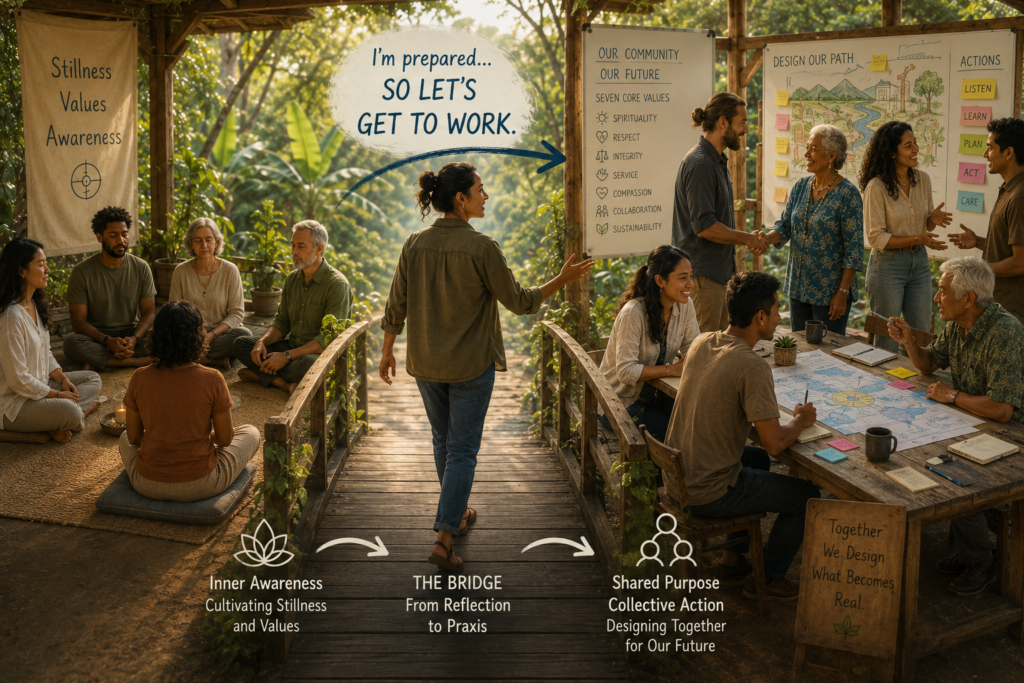
A Design Team is a small group of people who intentionally come together to address a meaningful question, challenge, or opportunity through shared discernment and collaborative design. Unlike conventional teams that often focus primarily on completing projects or solving problems, a co-creative Design Team recognizes that the quality of its work depends upon the quality of the relationships within it. As participants learn to listen deeply, reflect honestly, and think together from shared values, the team becomes not only a place for innovation, but also a place for human development.
What do we mean by a “Co-Creative Design Team”?
While both seek practical solutions to real problems, a co-creative Design Team also recognizes that the development of the participants is inseparable from the quality of the outcomes they create. It is therefore both a collaborative design process and a practice of human development.
Learning Beyond the Grade
Years ago, as a science teacher, I often heard the same question from students:
“What do I have to do to get an A?”
It was an understandable question. Grades mattered, and students naturally wanted to know how to succeed. Yet my answer was rarely what they expected.
The goal was never simply to earn an “A.” The goal was to learn how to think.
If students could learn to ask thoughtful questions, evaluate evidence, consider multiple perspectives, and make sound decisions based on what they understood, the grades would follow. More importantly, those habits of mind would remain long after the course had ended. Facts change. Technologies evolve. Information expands at an astonishing pace. But the ability to think critically, reflect honestly, and make wise decisions remains one of life’s greatest gifts.
Looking back, I realize that those conversations in the classroom were preparing me for a much larger question—one that extends far beyond education.
How do we learn to think together?
That question sits quietly beneath many of the challenges facing humanity today.
A Journey of Human Development
As you explore the pages of Planetary Pulse, you will notice that the magazine is organized into a series of pathways. They are more than editorial sections or collections of related articles. Together they represent a developmental journey.
We begin with Stillness and Awareness, learning to quiet the constant noise of everyday life so we can hear the deeper wisdom within. From there we move into Spiritual Meaning-Making, exploring how our experiences shape purpose, identity, and our understanding of the larger story of life. Those insights become grounded through Foundations for Growth, where universal values provide a stable framework for human flourishing. Ethics in Praxis then asks the essential question: How do those values become living decisions in our daily relationships and responsibilities?
Only after this inner work do we arrive at Design Team Collaboration.
A Design Team is a small group of people who intentionally come together to address a meaningful question, challenge, or opportunity through shared discernment and collaborative design. Unlike conventional teams that often focus primarily on completing projects or solving problems, a co-creative Design Team recognizes that the quality of its work depends upon the quality of the relationships within it. As participants learn to listen deeply, reflect honestly, and think together from shared values, the team becomes not only a place for innovation, but also a place for human development.
This sequence is intentional
Authentic collaboration is not simply a skill. It is the natural expression of a person who is learning to live with awareness, discernment, humility, and respect for others.
When Values Meet Reality
Our world does not suffer from a lack of intelligence.
It suffers from a lack of wisdom.
Human history is filled with brilliant minds that created remarkable inventions, advanced technologies, and powerful institutions. Yet those same gifts have often been directed toward division, exploitation, violence, and the pursuit of power at the expense of human dignity and the well-being of the planet.
The greatest challenges before us are not merely technological, political, or economic.
They are profoundly human.
Many people sincerely value compassion, honesty, equality, and justice. Yet when confronted with fear, uncertainty, competition, or personal ambition, those values can become difficult to live. Unexamined assumptions, hidden agendas, emotional wounds, and deeply ingrained patterns often shape our decisions more than we realize.
Knowing our values is important.
Learning to live from them requires practice.
A Place to Practice Becoming
This is where the Design Team becomes something much deeper than a meeting or a problem-solving technique.
A Design Team is a place to practice becoming.
Just as musicians rehearse before performing or athletes train before competition, human beings need places where they can intentionally practice listening, discernment, ethical decision-making, and respectful collaboration before attempting to solve increasingly complex challenges together.
The Design Team provides that opportunity.
It offers a carefully cultivated environment where people can observe not only the problems before them, but also themselves. Participants begin to notice the assumptions they bring into conversations, the lenses through which they interpret others, the agendas—spoken and unspoken—that influence their thinking, and the emotional habits that either strengthen or weaken relationships.
This work is rarely comfortable.
It requires humility.
It requires curiosity.
Most of all, it requires a willingness to discover that we do not always see ourselves as clearly as we imagine.
That is not a weakness.
It is part of being human.
The Art of Facilitation
For this reason, Design Teams rely upon skilled facilitators—not as authorities who possess all the answers, but as guardians of the process. The role of the facilitator is not to tell people what to think.
It is to help them learn how to think together.
Facilitators create environments where every participant can be heard with respect, where difficult conversations remain constructive, where hidden assumptions can gently surface, and where relationships become strong enough to support honest dialogue. They recognize moments when fear, defensiveness, or personal agendas begin to dominate and help the group return to shared purpose.
Daniel Raphael has long emphasized that facilitators benefit from understanding human psychology. This is not because they are therapists, but because they are entrusted with something deeply human: creating conditions in which people feel safe enough to grow.
Growth requires trust.
Trust requires safety.
Safety requires intentional leadership.
Trust, Stillness, and Inner Guidance
Perhaps one of the greatest challenges of our time is that trust itself has been deeply wounded.
Many people have experienced betrayal by those who held positions of authority—within families, religious communities, educational institutions, corporations, and governments. When trust has been broken, even sincere guidance can be difficult to receive.
This is one reason why the practice of stillness remains foundational throughout these pathways.
Authentic guidance cannot depend entirely upon external authorities.
It must also grow from within.
Across spiritual traditions we find reminders that wisdom is not something imposed from the outside but discovered through an honest relationship with the deepest truth we can perceive. Within the teachings that have shaped this magazine, that relationship is understood as communion with the Father Within—the divine presence that continually invites each person toward truth, goodness, beauty, and loving service.
Facilitators, mentors, teachers, and leaders remain important.
Their role, however, changes.
Rather than replacing an individual’s inner guidance, they help create the conditions in which that guidance can be recognized, trusted, and strengthened.
Becoming Before Building
The future will not be shaped simply by better systems.
It will be shaped by better human beings.
Before we redesign our institutions, we must learn to redesign the ways we participate within them.
Before we can build communities grounded in trust, we must become trustworthy ourselves.
Before we can solve humanity’s greatest challenges together, we must first learn how to listen, discern, and collaborate with humility.
That is the deeper purpose of the Design Team.
It is not merely a methodology.
It is a practice of becoming.
One conversation at a time.
One relationship at a time.
One community at a time.
Because the future of human flourishing depends not only on what we build together, but on who we become while building it.
Continue the Conversation
The future is shaped through thoughtful dialogue.
If this article has been meaningful to you, share the official Planetary Pulse link with someone who may also enjoy exploring these ideas.