
📰A Step-by-Step Guide for Sustainable Social Change
Introduction
Many people recognize the problems facing our world but feel powerless to create meaningful change. The Design Team Process offers a practical and ethical method for bringing people together to solve complex social, organizational, and community problems. Rather than relying on individual opinions or ideological debates, Design Teams use a structured process rooted in shared values, ethical decision-making, systems thinking, and collaborative leadership.
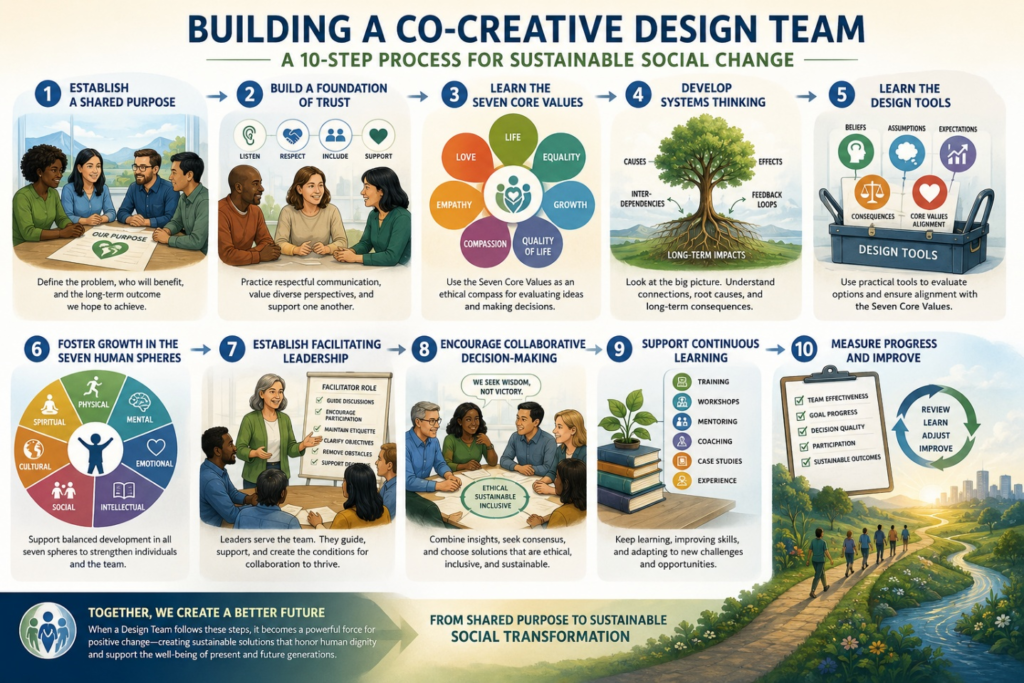
A Design Team is more than a discussion group. It is a learning environment where individuals work together to create sustainable solutions that benefit present and future generations. The following steps provide a roadmap for establishing and developing an effective Design Team.
Step 1 – Establish a Shared Purpose
Every successful Design Team begins with a clearly defined purpose.
Team members must understand why the team exists and what problem it intends to address. The purpose should focus on improving conditions for individuals, families, communities, or institutions while seeking sustainable long-term outcomes.
A shared purpose creates unity and helps members remain focused when discussions become complex or challenging.
Key Questions
- What problem are we trying to solve?
- Who will benefit from our work?
- What long-term outcome do we hope to achieve?
- How to measure the results
Step 2 – Build a Foundation of Trust
Trust is the social glue that holds a Design Team together.
Members must learn to listen respectfully, communicate honestly, and value diverse perspectives. Trust allows individuals to share ideas openly without fear of criticism or ridicule.
Strong Design Teams invest time in relationship building before attempting to solve major problems.
Key Practices
- Active listening
- Respectful communication
- Equal participation
- Mutual support and encouragement
Step 3 – Learn the Seven Core Values
The foundation of ethical decision-making is the understanding of the Seven Core Values:
These values provide a universal framework for evaluating ideas, policies, and proposed solutions. Team members learn how these values influence ethical and moral choices and how they contribute to sustainable outcomes.
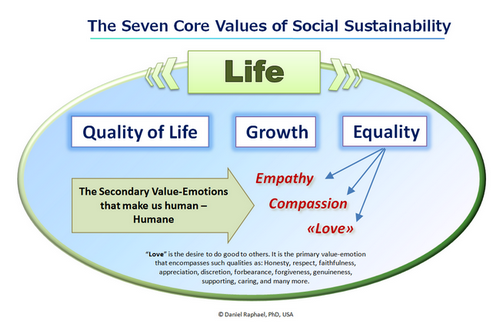
- Life
- Equality
- Growth
- Quality of Life
- Compassion
- Empathy
- Love
Before beginning major projects, every member should become familiar with applying these values to real-life situations.
Step 4 – Develop Systems Thinking
Most social problems are interconnected.
Design Team members must learn to think beyond isolated events and understand the relationships between causes, effects, and unintended consequences.
Systems thinking helps participants see the larger picture and recognize how decisions in one area may affect many others.
Important Skills
- Identifying root causes
- Understanding interdependencies
- Recognizing feedback loops
- Evaluating long-term impacts
Step 5 – Learn the Design Tools
A Design Team requires practical tools to evaluate options and guide discussions.
Members should be trained to use sustainability and decision-making tools that help assess:
- Beliefs
- Assumptions
- Expectations
- Potential consequences
- Alignment with the Seven Core Values
These tools create a common language that improves objectivity and reduces emotional decision-making.
Step 6 – Foster Growth in the Seven Human Spheres
A Design Team is not only about solving problems; it is also about developing people.
Members should strive for balanced growth in the Seven Spheres of Human Development:
- Physical
- Mental
- Emotional
- Intellectual
- Social
- Cultural
- Spiritual
As participants grow personally, the team’s
Step 7 – Establish Facilitating Leadership
Traditional leadership often focuses on directing others. Design Teams operate differently.
The most effective leaders act as facilitators rather than commanders. Their role is to help the group function effectively, encourage participation, remove obstacles, and maintain focus on the process.
This approach is often called servant leadership.
Responsibilities of the Facilitator
- Guide discussions
- Encourage participation
- Maintain team etiquette
- Clarify objectives
- Support collaborative decision-making
Step 8 – Encourage Collaborative Decision-Making
The collective wisdom of the team is often greater than the perspective of any individual member.
Design Teams seek consensus whenever possible and encourage all participants to contribute their insights. Decisions are evaluated according to ethical principles, sustainability, and their impact on future generations.
The objective is not winning arguments but discovering the best solution.
Step 9 – Support Continuous Learning
A Design Team is a learning organization.
Members should continually improve their knowledge, skills, and understanding through:
- Training sessions
- Workshops
- Mentoring
- Coaching
- Case studies
- Practical experience
Continuous learning allows the team to adapt to changing circumstances and remain effective over time.
Step 10 – Measure Progress and Improve
Successful Design Teams regularly evaluate their performance.
This includes reviewing:
- Team effectiveness
- Progress toward goals
- Quality of decisions
- Member participation
- Sustainability of outcomes
Regular evaluation creates a culture of continuous improvement and helps the team refine its methods over time.
Key Practices
- Establish performance indicators
- Conduct regular reviews
- Celebrate successes
- Learn from mistakes
- Adjust processes when necessary
Conclusion
Creating a Design Team is not simply a matter of gathering people together. It is a developmental process that combines ethical values, systems thinking, collaborative leadership, and personal growth.
When properly trained and guided, Design Teams become powerful instruments for social transformation. They help communities move beyond conflict and opinion toward thoughtful, sustainable solutions that honor human dignity and support the wellbeing of future generations.
In a world facing increasingly complex challenges, Design Teams provide a practical pathway toward co-creative problem solving and the conscious evolution of society.
Continue the Conversation
The future is shaped through thoughtful dialogue.
If this article has been meaningful to you, share the official Planetary Pulse link with someone who may also enjoy exploring these ideas.