
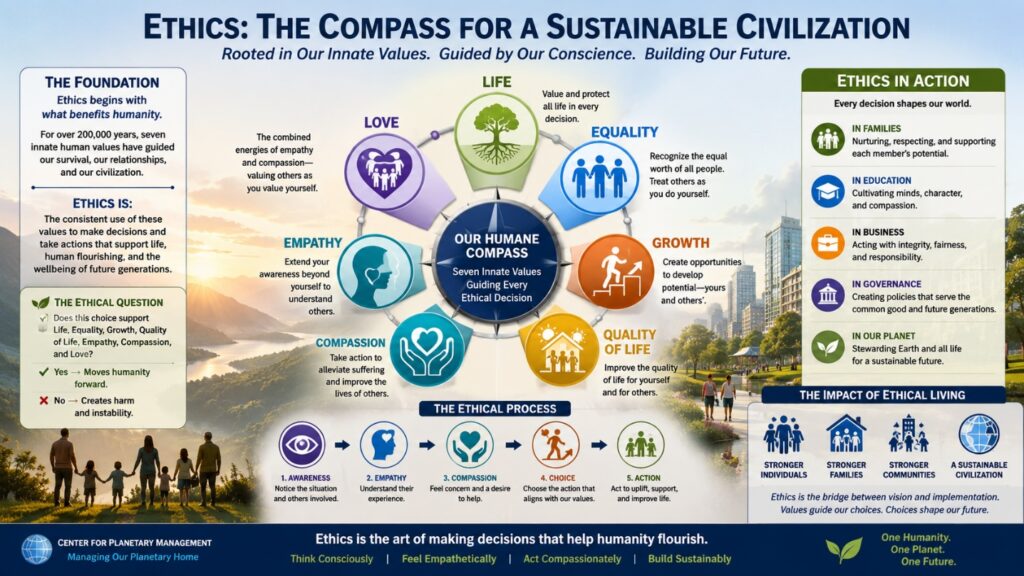
📰Why Ethics Matters Today
By the CPM Team, Jacques Reverseau June 2026
Based on the Books \101.01.08–Basis of Ethics by D. Raphael
The challenge facing humanity is not merely technological, economic, or political—it is ethical.
Every day individuals, families, organizations, and governments make countless decisions that affect the lives of others. Some decisions contribute to human flourishing, while others create suffering and instability.
The question becomes: How do we determine what is truly beneficial for humanity?
According to social philosopher Daniel Raphael, the answer lies within human nature itself.
Ethics Begins with Human Values
Traditional ethical systems often rely on philosophical arguments, religious teachings, cultural traditions, or legal codes. While these approaches have contributed valuable insights, they frequently differ from one culture to another and from one era to the next.
Raphael proposes a different foundation. He suggests that ethics originates from 7 innate human values that have enabled the survival and evolution of the human species for over 200,000 years.
These values are:
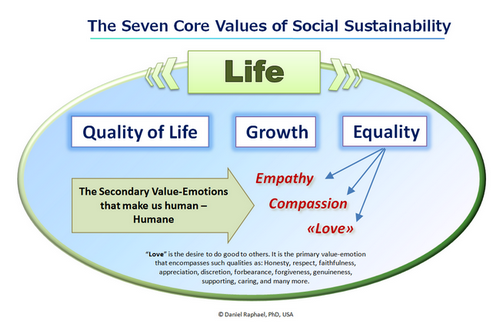
Rather than being learned behaviors, these values function as fundamental motivators embedded within human consciousness. They influence every decision we make, whether consciously or unconsciously.
From this perspective, ethics is not something imposed upon humanity. Ethics emerges from the deepest aspects of what it means to be human.
The Ethical Question
At its core, every ethical decision can be reduced to a simple question:
Does this choice support life, growth, equality, quality of life, empathy, compassion, and love?
If the answer is YES, the decision moves humanity toward greater sustainability and wellbeing.
If the answer is NO, the decision tends to create instability, division, suffering, or decline.
Ethics therefore becomes a practical process of evaluating the consequences of our actions through the lens of these universal values.
Equality: The Bridge to Our Humanity
Among the seven values, Raphael identifies Equality as the pivotal value from which empathy, compassion, and love emerge.
When we recognize the equal worth of another person, we begin to place ourselves in their situation. This is empathy.
When empathy moves us to assist another person, it becomes compassion.
When empathy and compassion expand to include all people, they become love.
This progression transforms ethics from an abstract concept into a living experience.
The ethical moment occurs when we recognize another person’s circumstances and choose to respond in a way that uplifts, supports, or improves their life.
Ethics in Practice
Ethics is not confined to philosophical discussions. It appears in everyday choices:
- A parent encouraging a child to reach their potential.
- A teacher helping students discover their talents.
- A business treating employees fairly.
- A government creating opportunities for all citizens.
- A community caring for its most vulnerable members.
Ethics is expressed through actions such as:
- Fairness
- Integrity
- Transparency
- Honesty
- Acceptance
- Forgiveness
- Patience
- Respect
- Validation
- Authenticity
These behaviors transform values into lived reality.
Beyond Personal Ethics
One of the most important contributions of Raphael’s work is the extension of ethics beyond individual conduct.
Modern civilization faces challenges that require ethical thinking at every level of society:
- Education
- Healthcare
- Economics
- Governance
- Justice systems
- Environmental stewardship
- Artificial Intelligence
When institutions operate without a consistent ethical framework, decisions often become fragmented and short-sighted. Policies may benefit a few while harming many. Systems become reactive rather than proactive.
A values-based ethic provides a common foundation for evaluating whether social systems are genuinely serving humanity.
Ethics and the Future of Civilization
The Center for Planetary Management often speaks of creating sustainable families, sustainable communities, and sustainable civilizations.
Ethics is the bridge between vision and implementation.
Without ethics, sustainability remains an ideal.
With ethics, sustainability becomes a practical pathway.
Every decision made by an individual, organization, or government either strengthens or weakens humanity’s future.
The Seven Innate Values provide a universal compass capable of guiding those decisions toward outcomes that benefit both present and future generations.
A New Ethical Consciousness
Humanity does not need more rules alone. It needs greater awareness.
When people become conscious of the values already present within them, ethics ceases to be an external obligation and becomes an internal guide.
- Life reminds us to protect existence.
- Equality reminds us of our shared worth.
- Growth urges us toward our potential.
- Quality of Life encourages us to improve human wellbeing.
- Empathy allows us to understand others.
- Compassion inspires us to act.
- Love unites all these values into a vision of humanity as one family.
The future of civilization may depend upon our willingness to consciously apply these values—not occasionally, but consistently—in every sphere of human life.
Ethics, then, is not merely a study of right and wrong. It is the art of making decisions that help humanity flourish.
We can conclude that: Ethics is the conscious use of the 7 Innate Human Values: Life, Equality, Growth, Quality of Life, Empathy, Compassion, and Love; to make decisions and take actions that support the long-term flourishing of individuals, families, communities, and civilization itself.
Continue the Conversation
The future is shaped through thoughtful dialogue.
If this article has been meaningful to you, share the official Planetary Pulse link with someone who may also enjoy exploring these ideas.