
📰Living Governance in Praxis
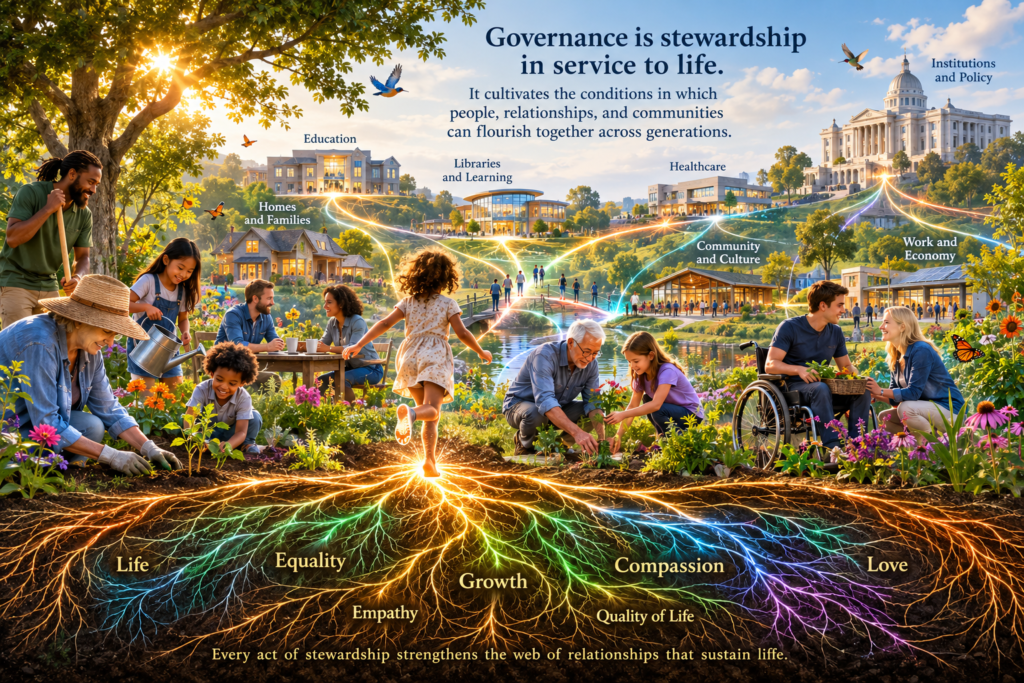
Governance is not primarily the management of institutions. It is the ongoing practice of ordering human relationships so that life, growth, equality, quality of life, empathy, compassion, and love can flourish across generations.
If values can shape individuals, and ethical relationships can transform families, teams, and communities, what happens when these same principles are extended into the institutions that shape society itself?
Every society is governed by something.
Sometimes it is governed by fear. Sometimes by tradition. Sometimes by competition, power, or economic necessity. At its best, governance is guided by shared values and a commitment to the common good.
In previous pathways, we explored the personal practices that cultivate awareness, ethical discernment, and collaborative relationships. This pathway asks a larger question:
How do those same capacities shape the communities and institutions we build together?
Governance in Praxis invites us to see governance not merely as the work of governments, but as the ongoing practice of stewarding the relationships that make human flourishing possible.
Governance is not primarily the management of institutions. It is the ongoing practice of ordering human relationships so that life, growth, equality, quality of life, empathy, compassion, and love can flourish across generations.
How do we create societies that work for everyone?
Every meaningful journey begins with a single step. Ours began by turning inward.
In Stillness and Awareness, we discovered that wisdom often emerges not through constant activity, but through the quiet practice of listening. We learned that before we can respond wisely to the world around us, we must first become aware of the world within us.
In Foundations for Growth, we explored the universal values that support human flourishing—life, equality, growth, quality of life, empathy, compassion, and love. These values provide more than an ethical ideal; they offer a developmental framework for individuals, families, organizations, and societies.
Then, in Ethics in Praxis, we were challenged to move beyond simply understanding these values. We began asking what it means to embody them in our everyday choices, recognizing that ethical living is not measured by what we profess, but by how we respond to one another in the ordinary moments of life.
Finally, through the Design Team Methodology, we discovered that wisdom is not only an individual achievement. Through this collaborative process, we begin to discover not only better solutions, but better ways of creating the families, organizations, and communities that future generations will inherit.
When people gather with humility, curiosity, and a shared commitment to the common good, discernment becomes a collaborative practice. We learn that the most enduring solutions rarely emerge from one person alone, but from relationships grounded in mutual respect and shared discernment.
These experiences prepare us for the next question.
If values can shape individuals, and ethical relationships can transform families, teams, and communities, what happens when these same principles are extended into the institutions that shape society itself?
That question leads us into governance.
Not government.
Governance.
II. Governance Begins Long Before Government
What is governance?
For many people, the word governance immediately calls to mind governments, elections, legislation, or public administration. While these are certainly expressions of governance, they represent only one part of a much larger human story.
Long before societies establish constitutions or institutions, people are already making decisions together. Every family develops patterns for resolving conflict. Every classroom establishes expectations for shared learning. Every neighborhood, workplace, nonprofit, and community creates ways of balancing individual needs with the well-being of the whole.
These everyday choices are acts of governance.
Governance begins wherever people ask a simple but profound question:
How shall we live together?
The answers to that question shape every relationship we build and every institution we create.
Seen in this light, government is one expression of governance—not its beginning.
Governance is the ongoing practice of ordering relationships, making shared decisions, and stewarding the conditions in which life can flourish.
Institutions give governance its structure. The wisdom, trust, compassion, and shared discernment that sustain healthy governance emerge through the quality of the relationships from which those institutions grow. This distinction matters because institutions inevitably reflect the consciousness of the people who create them.
Lasting social change cannot be achieved solely by redesigning systems. It also requires the ongoing development of the people who participate in them.
As individuals grow in wisdom, compassion, and the capacity for shared discernment, the communities and institutions they create begin to reflect those same qualities. In this sense, governance is not only concerned with the organization of society, but with creating the conditions in which people, relationships, and communities can continue to mature together. It is, ultimately, stewardship for human development—for what Marthe beautifully describes as the growth of souls.
Healthy relationships tend to cultivate healthy communities. Communities grounded in trust and shared values are more likely to build institutions that serve the common good. When relationships are fractured by fear, mistrust, or the pursuit of power, those same patterns often become embedded within the systems themselves.
For this reason, the work of governance begins long before we enter a voting booth, join a governing board, or participate in public policy. It begins whenever we choose how we will listen, collaborate, resolve differences, and care for one another.
Governance is not reserved for political leaders. It is a shared human responsibility practiced every day in the relationships that shape our common life.
III. The Scaling of Ethics
How do personal values become the values of a society?
If governance begins with relationships, then ethics does not end with individual choices. It expands.
The questions that shape our personal lives gradually become the questions that shape our families, workplaces, neighborhoods, communities, and ultimately the institutions that influence society.
These are not different questions.
They are the same question asked at different scales.
Every ethical decision carries consequences beyond the individual. The way we resolve conflict, share resources, welcome newcomers, care for the vulnerable, or respond to disagreement gradually shapes the culture around us. When these choices are multiplied across families, organizations, neighborhoods, and institutions, they begin to establish the patterns by which an entire society lives.
Governance is ethics practiced at the scale of society.
This understanding shifts our attention away from governance as a system of control and toward governance as a practice of shared responsibility. Laws, policies, and institutions remain essential, but they cannot substitute for the values and relationships upon which healthy governance depends.
The universal values explored throughout this magazine—life, equality, growth, quality of life, empathy, compassion, and love—do not become less important as our sphere of influence grows. They become more essential. The greater the complexity of our communities, the greater our need for wisdom, discernment, and a shared commitment to the common good.
Personal transformation and social transformation are not competing goals. They are expressions of the same developmental journey.
IV. Where Values Meet Reality
Why is living our values so difficult?
If living these values were easy, healthy relationships and thriving communities would already be the norm. Experience tells us otherwise.
Families experience conflict. Organizations struggle with competing priorities. Neighborhoods wrestle with differing perspectives. Communities face limited resources, cultural differences, and deeply held convictions. Nations confront problems for which no solution is without consequence.
These realities do not represent the failure of governance.
They are the reason governance exists.
The question is not whether conflict will arise. The question is how we choose to move through it.
Values do not eliminate disagreement. They provide a compass for navigating it. Equality may appear to compete with efficiency. Compassion may seem to conflict with accountability. Short-term needs may challenge long-term quality of life. Ethical discernment rarely offers simple answers. Instead, it invites us to remain in relationship long enough to discover wiser ones.
The purpose of governance is not to create a perfect society. It is to cultivate communities where people continue learning how to live wisely together.
This understanding also helps explain why so many organizations struggle to sustain positive change. New policies, improved structures, and inspiring visions often produce temporary progress, yet many organizations gradually return to familiar patterns of competition, mistrust, or disengagement.
The challenge is rarely a lack of good ideas.
It is the difficulty of consistently living them.
Throughout this pathway we have explored the intentional development of human capacities that support healthy relationships. Stillness cultivates the ability to listen before reacting. Foundations for Growth introduces the universal values that support human flourishing. Ethics in Praxis invites us to embody those values in everyday decisions. Design Teams create environments for practicing shared discernment, while Family Learning Centers intentionally nurture these capacities across generations.
These are not idealistic aspirations.
They are practical formation environments where people learn to navigate the very complexities that healthy governance requires.
V. Institutions Reflect Consciousness
What must change for healthy governance to become sustainable?
For generations, thoughtful leaders have sought to improve organizations by redesigning their structures, processes, and systems. These efforts have produced valuable insights into how healthy organizations function and the conditions that support collaboration and learning.
Yet experience has repeatedly demonstrated that changing structures alone rarely produces lasting transformation.
Institutions can invite new behaviors, but they cannot sustain capacities that people have not yet developed.
Organizations often invest tremendous effort recruiting people who already demonstrate integrity, responsibility, collaboration, sound judgment, emotional maturity, and self-management. Technical competencies can often be taught through education, training, and experience. The deeper capacities that shape how people work with others require a different kind of developmental environment.
This raises an important question.
If healthy institutions depend upon these human capacities, where are they intentionally developed?
For generations, families, faith communities, schools, and civic organizations have all shared responsibility for nurturing human character. Today, many of these formative environments face unprecedented pressures. Economic uncertainty, social fragmentation, rapid technological change, and increasing isolation have left many people trying to navigate life’s most important relationships with little intentional preparation.
The result is not simply struggling individuals or struggling organizations.
Many of the challenges we attribute to broken institutions are, at their heart, unmet developmental needs.
Healthy systems do not emerge by accident. They reflect the habits, values, and consciousness of the people who create and sustain them. As individuals grow in wisdom, compassion, ethical discernment, and collaborative capacity, the communities and institutions they build begin to reflect those same qualities.
Institutions give governance structure, but they cannot replace the quality of the relationships from which they emerge.
The work of governance is ultimately stewardship for human development—for what our colleague Marthe beautifully describes as the growth of souls. Healthy governance creates the conditions in which people, relationships, communities, and institutions can continue maturing together, enabling future generations to inherit not only better systems, but healthier ways of living within them.
Lasting social change, therefore, cannot be achieved solely by redesigning systems. It also requires the ongoing development of the people who participate in them.
VI. Stewardship as the Purpose of Governance
How do we govern relationships wisely?
If lasting social change depends upon the ongoing development of people as well as systems, then another question naturally emerges.
How do people who have developed these capacities actually govern together?
The answer lies in understanding the relationship between management and stewardship.
Management concerns itself with organizing people, resources, and processes so that work can be accomplished effectively.
Stewardship asks how our decisions are shaping the relationships entrusted to our care—with ourselves, with one another, with our families, our communities, the natural world, and ultimately with the Divine source of life.
These two practices are not competitors. They are partners. Healthy societies require both.
Management translates discernment into coordinated action.
Stewardship continually evaluates whether those same decisions are nurturing human dignity, encouraging continued growth, strengthening relationships, and contributing to the common good.
Management coordinates our actions. Stewardship governs our relationships.
Without effective management, even the most compassionate vision struggles to become reality. Without stewardship, even the most efficient systems risk losing sight of the relationships they exist to serve.
This distinction changes the way we evaluate success.
Rather than asking only,
“Did we accomplish our goals?”
Stewardship invites us to ask,
“How are our decisions shaping the relationships entrusted to our care?”
The universal values explored throughout this magazine—life, equality, growth, quality of life, empathy, compassion, and love—are not simply ideals to admire. They provide the orientation by which relationships are governed wisely.
Stewardship continually asks whether our decisions are strengthening the relationships upon which human flourishing depends. Management then gives practical expression to those decisions through structures, processes, policies, and the ordinary practices of everyday life.
Like a compass, these values do not tell us where we have arrived.
They help us remain oriented toward where we are called to go.
Values are not the destination of human development. They become meaningful only as they are practiced in service to life.
Ultimately, stewardship reminds us that governance is never merely about managing institutions.
It is about cultivating relationships that allow people, families, communities, institutions, and future generations to flourish together.
Healthy governance therefore depends upon both stewardship and management. Stewardship continually asks whether our relationships are being guided toward greater flourishing. Management faithfully implements the decisions that stewardship has discerned. Together they transform governance from the administration of institutions into the ongoing practice of cultivating a civilization where life can continue to flourish across generations.
The highest purpose of governance is not control. It is stewardship for human flourishing.
VII. Communities as Living Laboratories
Where do we learn to practice stewardship?
Healthy governance is not learned through theory alone.
Like ethics, stewardship develops through practice. The capacities that sustain healthy societies are formed over time through repeated experiences of listening, discerning, collaborating, and making decisions together. They are cultivated in the ordinary places where people learn how to live with one another.
Every family that intentionally nurtures trust, every workplace that values collaboration over competition, every neighborhood that learns to resolve differences with respect, and every community committed to the common good becomes a place where stewardship is practiced.
These everyday experiences matter because they prepare us for the larger responsibilities of society.
Throughout this magazine, we have introduced two practical formation environments that intentionally cultivate these capacities.
Design Teams are more than problem-solving groups. They are living laboratories of collaborative discernment where participants learn to ask better questions, listen deeply, navigate differences respectfully, and discover wiser solutions together. They remind us that healthy governance begins not with authority, but with relationships grounded in shared discernment.
Family Learning Centers extend this work across generations. They recognize that the capacities required for healthy governance—ethical discernment, empathy, responsibility, cooperation, and respect for life—are not acquired accidentally. They are intentionally nurtured within relationships that support continual human development from childhood through adulthood.
Neither Design Teams nor Family Learning Centers exist as ends in themselves. They exist because healthy societies require people who have learned how to live wisely together.
Stewardship is learned through practice long before it is expressed through institutions.
This understanding reshapes the way we think about community itself. Communities are not simply places where people live alongside one another. They become living laboratories where the values explored throughout this magazine are tested, refined, embodied, and passed forward to future generations.
As these capacities mature within individuals, families, and communities, they naturally begin influencing the institutions those same people create. Schools, businesses, healthcare systems, governments, technologies, and environmental initiatives increasingly reflect the consciousness and relationships from which they emerge.
The work of planetary stewardship therefore does not begin at the global level.
It begins wherever people choose to practice the qualities that make healthy relationships—and healthy governance—possible.
Every thriving civilization is built one healthy relationship at a time.
VIII. The Threshold Before Us
What future are we choosing to create together?
Every threshold marks both an ending and a beginning. It is the place where we pause long enough to recognize that what lies ahead will be shaped by the choices we make before taking the next step.
Humanity stands at such a threshold today.
Those are realities we must navigate, but they are not the deepest challenge before us.
For the first time in history, the decisions made by individuals, communities, organizations, and nations ripple across the entire planet with unprecedented speed and consequence.
It is found in the quality of the relationships we choose to cultivate, the values by which we govern those relationships, and the wisdom we bring to the decisions that will shape generations yet to come.
Throughout this magazine we have followed a developmental journey. We began by learning to listen. We explored the values that support human flourishing. We discovered that ethics is practiced through everyday choices. We learned that wisdom grows through relationships grounded in shared discernment.
We recognized that healthy institutions emerge from healthy people, and that stewardship provides the relational orientation by which governance serves life. Each step has prepared us for this moment.
The question before us is no longer whether humanity possesses the knowledge to build a sustainable civilization.
We do…
The question is whether we are willing to cultivate the awareness, relationships, and capacities necessary to live wisely together.
The future will be shaped not only by what we know, but by who we choose to become together.
That future will not be created by governments alone.
Nor by technologies.
Nor by institutions.
It will be created through millions of everyday decisions made by people who increasingly recognize that every relationship matters, every act of stewardship ripples outward, and every generation inherits the consequences of the one before it.
The threshold before us is therefore not something to fear.
It is an invitation.
An invitation to participate consciously in the ongoing work of cultivating lives, relationships, communities, and institutions that reflect the values upon which human flourishing depends.
Perhaps this is the deeper purpose of governance. Not simply to manage society. But to help humanity grow into the kind of civilization it is capable of becoming.
Every enduring transformation begins with the simple decision to take the next faithful step together.
Continue the Conversation
The future is shaped through thoughtful dialogue.
If this article has been meaningful to you, share the official Planetary Pulse link with someone who may also enjoy exploring these ideas.