
📰Every Seed Saved in Love
Across Africa, women have always been among the great keepers of life.
Long before governments, development agencies, and multinational corporations concerned themselves with food security, women preserved seeds, shared harvests, cared for children, passed down knowledge, and sustained communities through seasons of abundance and scarcity alike.
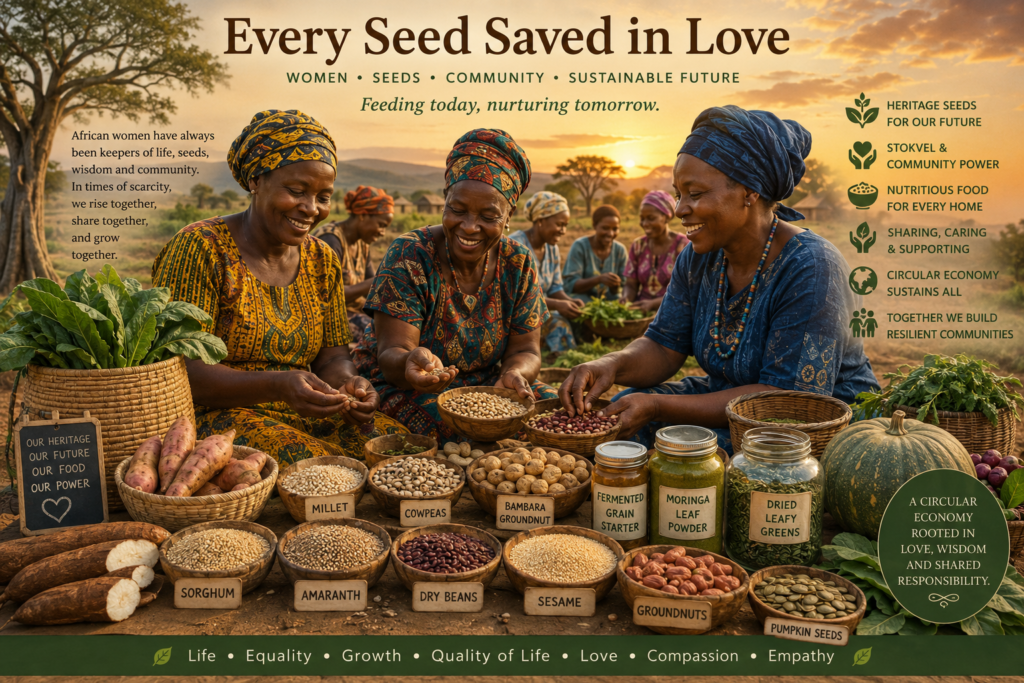
In many places, these traditions continue today through extended families, community gardens, informal markets, and mutual-support systems such as stokvels. Yet in a world increasingly shaped by economic uncertainty, climate disruption, and growing food insecurity, these ancient practices may hold important lessons for the future. What if some of the solutions to our greatest challenges are already present within our communities? What if the seeds of resilience have been quietly preserved by grandmothers, smallholder farmers, and women whose knowledge has often gone unnoticed?
The celestial teachings associated with the Correcting Time frequently remind us that sustainable societies are built from the ground up. They emphasize the human family as the foundational unit of civilization and encourage forms of decision-making rooted in life, equality, growth, quality of life, love, compassion, and empathy.
A women-led circular food economy embodies all these values in practical form. At its heart, such an economy is not simply about growing food. It is about nurturing relationships, preserving knowledge, restoring dignity, and strengthening communities. Rather than depending entirely on distant supply chains, communities can begin cultivating local resilience through seed saving, food production, preservation, and cooperative exchange.
Small groups of women can organize around shared gardens, communal food reserves, seed libraries, drying projects, savings circles, and educational initiatives. Each participant contributes according to her abilities while benefiting from the collective strength of the whole.
The model is remarkably simple. One group may focus on preserving heritage seeds. Another may cultivate grains or legumes. Others may specialize in medicinal herbs, fruit preservation, nutrition education, or water stewardship. Together they form a living network of mutual support. Such systems are not new. They reflect principles that have sustained communities throughout human history.
Particularly important is the preservation of indigenous and heritage crops adapted to local conditions. Many of these plants possess qualities that modern industrial agriculture has often overlooked: drought tolerance, nutritional density, seed-saving potential, and resilience under difficult conditions.
Foods such as sorghum, millet, cowpeas, Bambara groundnuts, amaranth, moringa, sesame, pumpkins, sweet potatoes, cassava, and indigenous leafy greens offer not only calories but also protein, minerals, vitamins, and long-term food security. These crops represent more than agricultural resources. They are repositories of culture, memory, and wisdom. The preservation of seeds is therefore inseparable from the preservation of knowledge.
Many older women still remember planting cycles, food preservation techniques, medicinal uses of plants, and methods of caring for soil and water that have been refined over generations. As younger generations move toward urban environments and modern lifestyles, some of this knowledge risks being lost. Yet every conversation between a grandmother and a child can become an act of cultural preservation. Every seed exchanged becomes a lesson in stewardship. Every communal garden becomes a classroom.
The long-term vision is not merely food production but the creation of resilient communities capable of caring for one another during times of uncertainty. Community food reserves, seed exchanges, educational gardens, cooperative enterprises, and local processing initiatives can all contribute to this resilience while generating livelihoods and strengthening social bonds. Perhaps most importantly, such efforts restore a sense of agency. Instead of waiting for solutions to arrive from elsewhere, communities become active participants in shaping their own futures.
The success of stokvels across Africa offers a powerful example. These systems flourished because they were built on trust, reciprocity, and shared responsibility. A resilient food economy can grow from the same foundation. The deepest lesson may be that food security is ultimately about more than food. People hunger for belonging as much as bread. They hunger for dignity as much as income. They hunger for hope as much as material security.
When communities gather around seeds, gardens, children, and shared purpose, they nourish all of these needs simultaneously. The future will undoubtedly present challenges. Yet it also presents opportunities to rediscover enduring truths. A seed is a remarkable thing. It carries within itself both memory and possibility. It preserves the wisdom of the past while reaching toward the future. Perhaps that is why the work of saving seeds feels so deeply hopeful. Every seed planted becomes an expression of faith. Every harvest becomes an act of gratitude.
And every seed saved in love becomes an act of hope for generations not yet born.
Continue the Conversation
The future is shaped through thoughtful dialogue.
If this article has been meaningful to you, share the official Planetary Pulse link with someone who may also enjoy exploring these ideas.